
Rezzipes for Cats
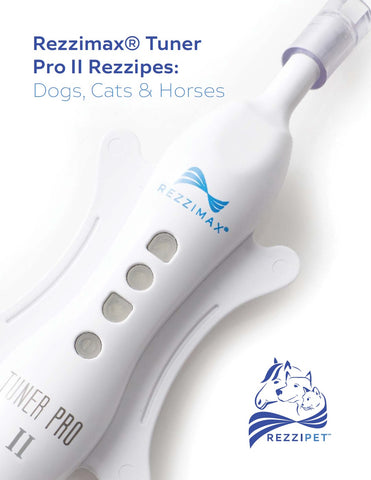
This Rezzipe Book is a step-by-step guide intended to assist you in using the Rezzimax Tuner Pro II on your pet. Follow each step as you would a recipe. It will provide you with basic techniques for supporting your pet’s natural healing. It is divided nose-to-tail based on where pain or tension is currently felt. After following
these, feel free to develop your own Rezzipes and share with us what works best for your pet!
**Do not leave pets unsupervised with the Tuner Pro II or any of its accessories. Do not allow your pet to ingest any part of the Tuner Pro II or its accessories.
Disclaimer: These techniques are not intended to diagnose, cure, or treat diseases.
The Basics:
It is important to start introducing your pet to the device slowly, and with rewards, to create a positive experience. Show it that the Tuner is safe by using the Tuner Pro II on yourself first. Your pet will map your response to the device and will be more receptive to it. Follow the instructions below or visit our Getting Started tutorial to learn how to use your device.
2. As you work with your pet, watch for the following:
• Licking the lips
• Yawning
• Chewing
• Taking a deep breath
When your cat shows these responses but are not showing signs of anxiety or stress, then these responses signify that its nervous system is becoming more in tune with its body. This primes its body for healing.

Rezzipes for Cats
Whole Body
Head & Neck
Back, Chest & Abdomen
Gastrointestinal System
Legs
Hind End, Pelvis & Tail
Rezzipes by Condition
Anxiety - Whole Body
Arthritis
• Neck - Head & Neck
• Spine - Back, Chest & Abdomen
• Legs - Legs
• Osteochondritis Dissecans (OCD) - Legs
Behavioral Issues - Whole Body, Head & Neck
Cystitis - Back, Chest & Abdomen, Gastrointestinal System
Diarrhea - Gastrointestinal System
Digestive Problems - Gastrointestinal System
Dystonia - Back, Chest & Abdomen
Emotional Issues - Whole Body
Epaxial Muscle Disease - Head & Neck
Feline Audiogenic Reflex - Head & Neck
Feline Orofacial Pain Syndrome - Head & Neck
Irritable Bowel Syndrome (IBS) - Gastrointestinal System
Immune-Mediated Disease - Head & Neck
Inflammation
• Abdominal - Gastrointestinal System
• Inflammatory Bowel Disease (IBD) - Gastrointestinal System
• Back or Chest - Back, Chest & Abdomen
• General - Whole Body
• Head or Neck - Head & Neck
• Leg - Legs
• Tail - Hind End, Pelvis & Tail
• Intervertebral Disc Disease (IVDD) - Back, Chest & Abdomen
• Cervical IVDD - Head & Neck
Ligament Disease - Legs
Myoclonus/Muscle Contraction Disease - Back, Chest & Abdomen
Pain
• Abdominal - Back, Chest & Abdomen
• Back or Chest - Back, Chest & Abdomen
• Head or Neck - Head & Neck
• Leg - Legs
• Nerve - Whole Body
• Tail - Hind End, Pelvis & Tail
Pelvic Issues - Hind End, Pelvis & Tail
Rhinitis/Sinusitis - Head & Neck
Seizures - Head & Neck, Legs
Soft Tissue Injury - Legs
Stomatitis/Resorptive Lesions - Head & Neck
Stress - Whole Body
Temporomandibular Joint Disorder (TMD) - Head & Neck
Trauma
• Abdominal - Gastrointestinal System
• Back or Chest - Back, Chest & Abdomen
• Emotional - Whole Body
• General - Whole Body
• Head or Neck - Head & Neck
• Leg - Legs
• Tail - Hind End, Pelvis & Tail
Vestibular Disease/Head Tilt - Head & Neck
Weakness
• Back or Chest - Back, Chest & Abdomen
• General - Whole Body
• Head or Neck - Head & Neck
• Leg - Legs
• Tail - Hind End, Pelvis & Tail